


Decades of Research Help Scientists Investigate Southern Right Whale Calf Mortality
An unusually high number of newborn southern right whale deaths at Península Valdés has prompted an intensified investigation, supported by more than two decades of systematic health monitoring in the region.
Each year, southern right whales return to the protected waters around Argentina’s Península Valdés to give birth and raise their calves. Scientists have studied this population for decades, building an increasingly valuable record of whale health that is now providing essential context as researchers investigate higher-than-usual mortality among newborn calves this season.
Dr. Marcela Uhart, Latin America Program Director at the UC Davis One Health Institute, is leading the investigation with a team of local and international collaborators. In Península Valdés, the field team is responding to strandings, documenting each case, examining carcasses, and collecting diagnostic samples, with critical support from municipal and provincial park rangers, wildlife authorities and other local collaborators.
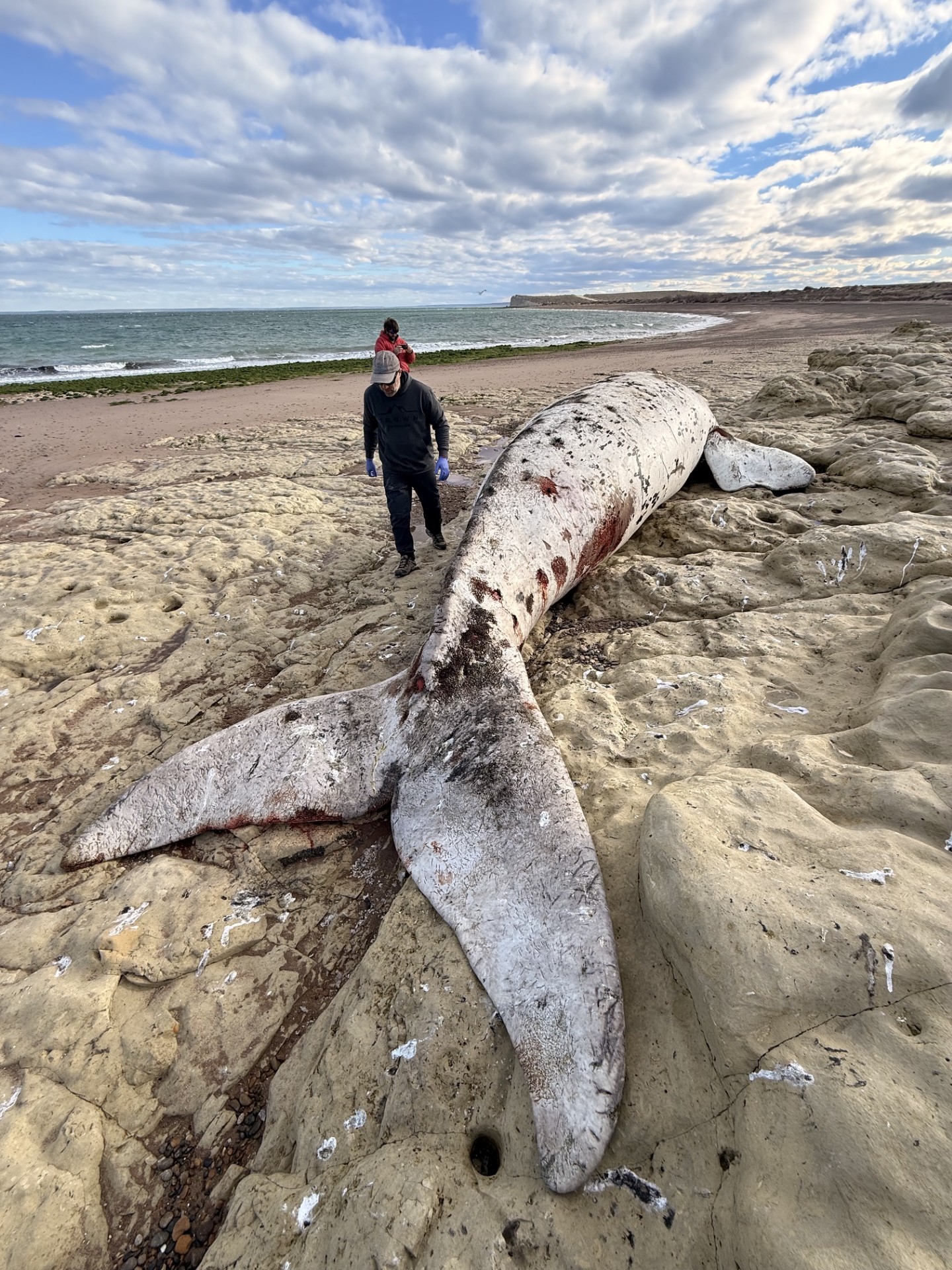
The cause of the deaths is not yet known. Determining what may be contributing to the mortality requires integrating field observations, necropsy findings, laboratory results and historical information. More than two decades of systematic monitoring allow researchers to compare what they are seeing this year with patterns documented in previous seasons.
“When something unusual happens, the value of long-term monitoring becomes especially clear,” Uhart said. “Because we have followed this population consistently for more than two decades, we can understand what we are seeing this season in the context of what has happened before. Maintaining that record is essential — not only for investigating events like this one, but for recognizing changes in whale health over time.”
More than two decades of monitoring
Research on southern right whales at Península Valdés dates back to the 1970s, with systematic post-mortem health monitoring of stranded whales beginning in 2003. Uhart has been at the forefront of that work for more than two decades, collaborating with Argentine and international researchers and conservation partners to investigate mortality and build a long-term picture of the population's health.

Since then, teams have responded to hundreds of strandings, conducting necropsies, collecting biological samples, and documenting patterns over time. This long-term record provides an essential baseline for recognizing significant changes and investigating their possible causes.
Southern right whale mortality at Península Valdés has varied considerably among years. Between 2003 and 2012, for example, 605 southern right whales were found dead along Península Valdés; nearly 90% of those recorded deaths were calves. Researchers investigated potential factors ranging from infectious disease and nutritional stress to algal biotoxins and injuries.
Other years have presented different patterns. In 2022, an unusual mortality event primarily affected adult females. Diagnostic testing and environmental evidence supported exposure to harmful algal bloom toxins as the most likely cause of that event.
From the shoreline to the laboratory
This season’s investigation begins with the people responding to whales along the coast. Uhart leads the Southern Right Whale Health Monitoring Program, whose core field team — including Santiago Fernández, Matías Di Martino and Marcos Ricciardi — is working with local rangers, wildlife authorities and a broad network of collaborators to locate and document carcasses and obtain samples while the animals remain suitable for sampling and diagnostic testing.

Those samples are then moving through a suite of specialized laboratories. At the School of Veterinary Medicine at Universidad Nacional del Centro de la Provincia de Buenos Aires (UNICEN), Dr. Silvia Estein’s laboratory team, and Dr. Juan Manuel Herrera, have prioritized the investigation and are completing key diagnostic work on an accelerated timeline. Estein, who leads the Immunology Laboratory, is carrying out the microbiological testing to look for potential bacterial involvement. Herrera is preparing histology slides from formalin-fixed tissues that will be examined by Wildlife Conservation Society pathologist Dr. Denise “Dee” McAloose, who has served as the Southern Right Whale Health Monitoring Program’s pathologist since its inception. This work has also received direct institutional support from the Dean of UNICEN’s School of Veterinary Medicine, Dr. Claudio Machado, and Vice Dean Dr. Andrea Caselli, helping facilitate a rapid and coordinated diagnostic response.
Bringing together field observations, pathology, microbiology, immunology and other diagnostic approaches is critical. Individual findings may be important clues, but they do not necessarily explain why an animal died — or why many animals may be dying during the same season. Researchers must evaluate the results collectively before drawing conclusions about the cause or causes of the event.

Building knowledge one season at a time
This season's newborn calf mortality presents another important question for the long-running monitoring program. Each necropsy, observation and biological sample adds to the evidence researchers can examine, while the historical dataset allows the team to interpret those findings in the context of more than two decades of previous observations.
Wildlife mortality investigations can take time. Laboratory analyses, pathology and other diagnostic work are needed to determine which findings are significant and how they fit together. Long-term surveillance provides the context needed to recognize changes, investigate potential causes and better understand how the health of a wildlife population may reflect broader changes in the environment.

The unusually high number of strandings this season is also placing exceptional demands on the team’s field and diagnostic work. Additional support will help sustain timely, high-quality response efforts through the remainder of the season, including the collection, storage, shipment and analysis of critical samples.
For Uhart and her collaborators, continued monitoring at Península Valdés strengthens both the investigation underway today and the ability to recognize and respond to changes in southern right whale health in the future.